Material applications
WeftTrail Procurement application requirements for yarn and reinforcement projects
FREE sourcing support and up to 3% coordination support for qualified programs. Eligibility applies to qualified business buyers and is confirmed after we review your product, quantity, destination, and sourcing requirements.
A buyer brief, comparable material options, clear supplier responsibilities.
Material applications
This page translates a project into purchase fields. It is supporting content, not a second copy of the home acquisition keyword. Apparel knitting, industrial sewing thread, outdoor filament packages and carbon-fiber reinforcement programs all need end-use language before a mill can quote honestly.
| Decision | Evidence to request | Boundary |
|---|---|---|
| Describe end use and exposure conditions | Written duty: next-to-skin, industrial abrasion, outdoor light, resin layup or sewing thread path | Confirm in writing; do not infer duty from a brand search |
| Identify the test method and sample condition | Method title, edition, specimen, conditioning and whether the sample is greige, dyed or impregnated | A public ASTM listing is a question list, not a product result |
| Match quantity, finish and usable width to the application | Unit (kg, cones, yards, rolls), finish or oil content, usable width or package length | Yield claims stay open until the converting process is named |
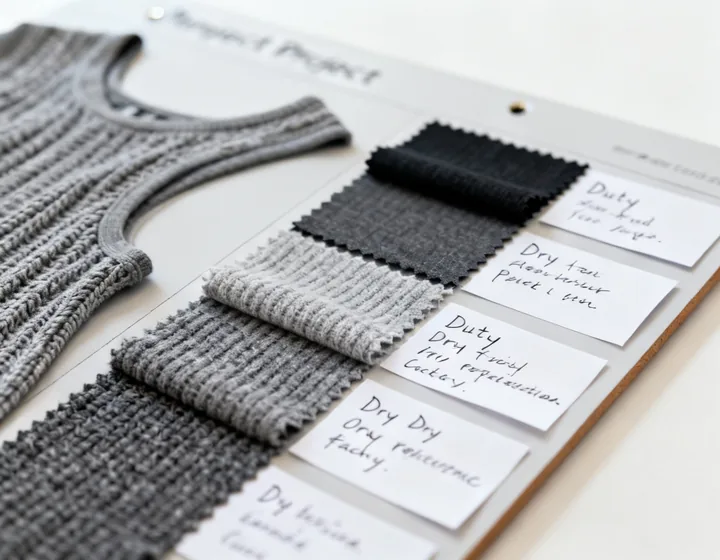
Apparel programs should state whether the yarn will be knitted, woven or over-sewn, and whether shrinkage, colorfastness or pilling will be checked on fabric rather than on the package. Industrial converters should name winding tension, splice policy and whether oil must be removed before dyeing. Reinforcement buyers should name fiber areal weight, weave or non-crimp style, binder, and whether the incoming article is dry fabric or a prepreg. Documents that travel with the goods—packing lists, roll maps, residual-size notes—belong in the RFQ so suppliers can price the same handover. Site constraints such as cone diameter, carton weight or roll-core size should be listed as physical limits, not as afterthoughts on the loading dock. WeftTrail Procurement will help line those fields up; we will not invent an application the buyer has not described.
Delivery stages are also application facts. A development cone that is couriered for knitting trials is not the same shipment as a production lot that must match a retained package after dyeing. If the project needs overlapping lots, say so, because dye-lot and tow-lot mixing rules change cost and waste. If the destination is a US cutting room, warehouse or composites cell, write that address class even when a street map is not published on this site. Optional budget should name currency and whether the figure is per kilogram, per cone or for the whole order. Supplier preference remains a buyer bias toward documentation intensity, not a league table of mills.
A stock yarn or reinforcement can shorten sampling when count, twist, oil, weave and finish already fit the retained package. Custom development can align construction and finish, but it needs explicit minimums, lab-dip or strike-off rows, and a written approval sequence. Neither path is automatically cheaper: stock may still fail after dyeing, and custom may add sample charges without improving yield. Record which path you are requesting so mills do not quote a warehouse article against a development brief.
A low unit price can be useful when usable width, fabric weight in g/m² or oz/yd², moisture regain, winding, testing and US destination are identical. It can also hide omitted dyeing, twisting, resin impregnation, roll maps or third-party lab fees. Ask each mill to restate the same quantity unit and the same inclusion list before ranking numbers. WeftTrail Procurement compares those restated lines; it does not publish a savings percentage.
A fiber-family brochure helps discovery. Incoming inspection still needs the quoted article, batch or roll list, method title and edition, and the specimen condition. Colorfastness, abrasion, pilling, tensile strength, tear strength, hydrostatic pressure or moisture vapor transmission results travel with that article identity, not with a third-party brand search. If a file does not name the quoted item, mark it incomplete.
Include end use, documents, delivery stages and any site constraints so quotations can be scoped.
Qualified programs may also receive up to 3% coordination support. Eligibility applies to qualified business buyers and is confirmed after we review your product, quantity, destination, and sourcing requirements.
This is not a lowest-price promise, a fixed discount, or a time-limited offer.